Before, I took my coffee sweet — now I like it black.
Everything changes.
The weather, the planet — even you.
Anything that changes — how can it be the truth?
Your body, your opinions, your identity — they all change.
You are not who you were a second ago.
So, is truth only relative —
to context, to circumstance, to time itself?
Then who are you?
Is there something unchanging beneath all that moves?
Or are you simply what you are in this moment—
not who you were or who you will be?
Life unfolds before us.
A child becomes an adult.
A bird crosses the sky.
Rain falls and seeds sprout.
Everything appears in relationship—
each thing shaped by countless other things.
In this continuous movement of change,
amid this web of interconnected beings and events,
where are you?
Are you merely another object within the unfolding?
Or are you the one to whom it unfolds?
Who are you?
Are you the observer of your mind —
sensations, thoughts, emotions?
Or the observed —
a part of your mind observing itself?
Are you a separate, independent observer from the rest of humanity?
Or is there an all-seeing observer —
one who is showing you what you need to see?
Or is there no observer at all —
only the act of seeing itself?
Observer vs Observed
You wake up.
You see your phone.
The phone is seen.
You are the one seeing it.
The book Dṛg-Dṛśya-Viveka offers this simple insight:
The Seer is not the Seen.
The Knower is not the Known.
The Aware is not what it is aware of.
You see your body and know your thoughts.
So it seems you are neither the body nor the mind.
But what, then, is the seen?
When you look at a known object — say, an apple —
what are you actually seeing?
The apple?
Or yourself?
The word apple lives in the mind —
its meaning, associations, memory.
So are you seeing the thing before you,
or the reflection of what you already know?
You might say, “It’s both.”
But really — how much of the real apple do you see,
and how much do you assume you have seen?
Let’s take another path.
Let’s say you are seeing the apple for the first time.
In that first moment of seeing,
if you are not caught in fear or desire —
what remains?
In that instant of wonder,
in that silence of the mind,
there is only the apple.
There is the observed without the observer.
The observer ceases.
Only the observed remains.
Universal vs Independent Observer
At birth, is there really much difference between you and another?
We’ve seen the observer is neither the body nor the mind.
As the mind fills with experiences, images, and thought,
this openness seems to fade.
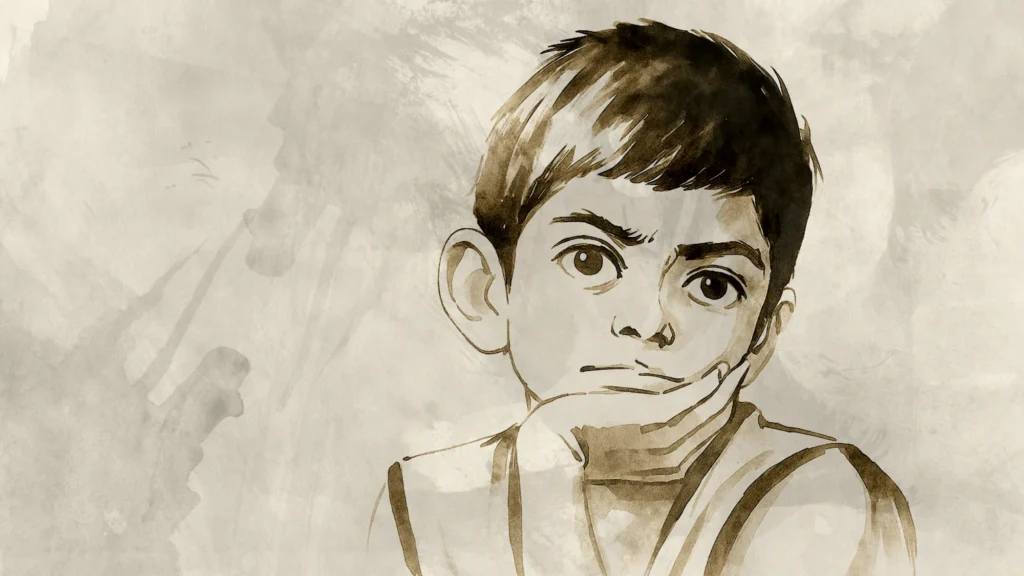
Look at a young child.
She can be angry one moment
and laughing the next.
Not untouched by experience,
but not yet heavily burdened by belief,
comparison, and self-image.
As we grow,
the mind gathers memories, conclusions, and identities.
Gradually, we come to see through these accumulated images
and mistake them for direct perception.
So is the openness of a child
truly lost?
Or is it still there,
hidden beneath the noise
of what we have accumulated?
Behind Mind
Without clarity, we are the mind —
the observer and the observed tangled within.
The mind sees only itself.
But when there is clarity of the suffering it creates,
the mind begins to withdraw from its own movement —
its experiences, explanations, and emotions.
Without the mind,
there is no you —
at least not the one you think you are.
And when that you dissolves,
there is only one thing left:
everything else.
The dissolution of mind is not achieved through effort or time —
it happens in the clear observation
of the suffering the mind brings.
The Extraordinary Ordinary
When the false you dissolves,
your senses are no longer interrupted, judged, or named.
Thoughts become transparent.
Emotions lose their grip.
You are neither sad nor happy —
neither high nor low.
You are simply —
extraordinarily ordinary.
This you
feels unchanging,
silent,
spacious.
Perhaps this is what remains.
Perhaps this isn’t personal at all.
Perhaps it’s the same in everyone.